End of year

Wednesday, November 27th, 2013

From now until sometime after New Years, air travel becomes more than just flight. Since I fly year round, I was going to be here anyway, but somehow there’s just more to it right now. Maybe it just seems more meaningful at either end, and maybe it really is. It could be sharing space with believers, the hype of Xmas commercialism or just the kids growing up so fast and getting swept up in the moment. But it always seems faster and more condensed. Added to this having family on both sides of this great nation I have the stress of making Chrissy lunch. For all of us it is the holiday pilgrimage to family and home, tradition, reunion, togetherness. More than just a flight, we’ll make a passage together.

So now I have landed and my passengers deplane safely into the arms of family and friends, I’ll turn right around and retrace the flight path with more holiday pilgrims, connecting them with the places the people and things that matter to them. Maybe all of our lives are reflections of each other and hence everyone is experiencing exactly the same thoughts and feelings.

But for now Happy holidays everyone.

Ferry or Fairy

Wednesday, November 27th, 2013

It always amazes me how little things can have major impacts on how the jet operates and how you operate the jet.

We do our heavy maintenance for the 737 in New Zealand so our most likely Ferry destination is Christchurch.

I have always liked Christchurch. Beautiful weather although a

wee bit cold

as the locals would say. I really feel for them with the devastation that occurred and continues to plague them from earthquakes.

Back to my point small things can have big consequences. For a ferry you have no passengers. Obviously that makes the plane lighter with the flow on affects of better performance low fuel burns slower key speeds. But with 70% of problems on flights coming from passengers it makes these flights a breeze.

BUT from my experience you some how feel a lowering of responsibility or risk for it is just you and the FO. Which is obviously wrong. I have experienced normally very conservative competent pilots suddenly make spurious decisions for no obvious reason other than they have no passengers on board. Is it the no uniform, is it the sense of responsibility or the sense of freedom I don’t know.

Now I am not trying to launch into a discussion on chaos theory or alike but it all comes down to mindset. And passengers should make no difference.

Oh the title comes from how NZ pronounce Ferry. My unreserved apologies in advance for any offense cause by an accent gag.

Pillow menu

Wednesday, November 20th, 2013

Why is it that hotels offer pillow menus? You jokingly state all the logical conclusions including but not limited to:

Fluffy ones
Flat ones
Hard ones
Latex ones
Everyone’s different! I hear you shout hotels are just adding value meeting the needs of their guests. The business hats amongst you say the hotel is adding a point of difference to its competitors to increase sales loyalty and ultimately profit.

But does this menu help with the thing you need most a good nights sleep? For unless you are on a dirty weekend away with the one you love. Sleep is all this bed is for.

Sleep is about relaxing the mind and having to make another decision at the end of the day right before I go to sleep is just unnecessary. You wake in the middle of the night was it the pillow? Should I have gone with latex instead of fluffy? You get my point. When you spend about 100 nights a year in a hotel like I do 5 different pillow types multiplied by 100 nights. That’s 1200 combinations and choices that I just don’t need.

Plane fuelishness

Sunday, November 17th, 2013

Aviation like life is full of axioms. Common sense rules to educated and guide us through work and life. One of my favorites is “the only time you have too much fuel is when you are in fire”. Now on face value insightful sage advice this statement is, but, does that mean you always take as much fuel as you can?

Now our flight planning system won’t issue a fuel load until one hour prior to the flight due to dynamic load planning or “bums on seats” changed. The issue here as crew is we show up one hour prior and by then, the fuel is already being pumped into the jet. Now to further complicate matters fuel is really expensive at some airports, including taxes, airport assessments and surcharges. So it does make sense to “ferry” some fuel into those airports. In my experience the places that have the most expensive fuel always have the shortest runways or the biggest hills around them which all put restrictions on the weight you can carry out or into them.

To figure out how much fuel you can carry you subtract the zero fuel weight, which is the weight of the aircraft plus passengers from the max landing weight. Then deduct the planned enroute fuel burn and see what is left over–THAT , minus a safety buffer and you’ll have a reasonable ferry fuel load.

The problem is, by the time I get to the jet, the “planned” fuel load–which doesn’t include the above calculation, because the zero fuel weight isn’t firm yet–is often aboard. If I do the math and find that we’ll be arriving weighing over the max landing weight, I have two choices: defuel (bad choice) before pushback or fly lower (dumb choice) to reduce the landing weight.

Both are bad options: if we defuel, that fuel must be discarded–trashed–because quality assurance standards wisely say you cannot take fuel from one aircraft’s tanks and meet the purity standards for another aircraft. So that money in the trash, plus a guaranteed delay to accomplish the defuel.

Fuel is time, to me, so nothing could be more important than more fuel if the maths supports it. Save the money safe comfortable profitable flight job done.

Unless as I noted above, you’re on fire, or more realistically, as I’ve just explained, you’re trying to achieve the best outcome as efficiently as possible. Anything less is just plane fuelishness.

Who says men can’t do two things at once

Sunday, November 17th, 2013

When pushing back from an aero bridge the Captain is normally starting engines using his right hand, he is also steering the plane via the tiller which is in his left hand. The steering instructions are coming from the dispatcher on the ground controlling the power push unit (ppu) so the captain is listening to this in his left ear while also keeping an ear out for air traffic control (ATC) instructions via his right ear.

Now in aviation nothing happens for very long periods of time then everything happens at once. And this push back and start sequence is no different. It is not uncommon to have the right hand moving the start lever to start while steering with the left hand and hence getting a steering instruction from the dispatcher and having ATC give us traffic info. All the while making sure the million dollar engines are safely and correctly started.

So I say to you patting your head while rubbing your tummy is child’s play compared to this. One day I will do a study to see if girl pilots find this easier.

Nitrogen

Thursday, November 14th, 2013

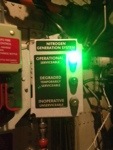
Great addition to the NG this system. Shows that while Boeing is the best plane maker in the world they recognize that improvements can always be made. Much like us as pilots really. We try so hard to have it squared away. But improvements can always be made.

20131114-071200.jpg

Push back

Thursday, September 19th, 2013

All the vision in a plane flight deck is forward. Understandable yes? But when we leave the gate, what we call push back, we go backwards. These days the Captain steers, or the First officer if dual tillers installed, while the power push unit (ppu) drives. During this process you have ground control (ATC) the engineer, controlling the push steer right steer left, and starting engines. I can’t juggle but this should qualify.

You can’t see the ground crew, but the disembodied voice below respects the red beacons top and bottom flashing warning: these engines will come to life and suck you off your feet if you get within 25 feet once we light the fire.

With both engines running, she’s awake and coursing with her own power; hydraulics, electrics, pneumatics, like a track star stretching through the flight control check. Fuel check all a ok.

Nose to the blue, darkening to the east where the day expires like a prayer unsaid off to another place another time the challenge is a foot which I never tire of – bring it on.

The theory of replaceability

Thursday, September 19th, 2013

This theory is well illustrated by S Levitt. The typical prostitute earns more than an Architect. It may not seem that she should. The architect would appear to be more skilled and better educated. But little girls dont grow up dreaming of becoming a prostitute so the supply is limited. Added to this the job is unpleasant and forbidding therefore they are hard to replace. None of these factors are in play for Architects which manifests in their pay.

Now lets look at lotto. The $10 bucks you spend on your ticket is easily replaced combined with the allure of the $10 million prize blinds you to the fact that you have a 1 in 8 million chance of winning.

Where there is a disconnect between the pay and the replaceability makes those jobs highly vulnerable to shifts in markets.

Thought of the day

Thursday, September 19th, 2013

othing wears a pilot out like watching the other guy fight the jet. And nothing degrades flight performance like the inevitable outcome–the jet wins, as it should.

This pointless tail chase arises out of two competing malignancies. First, there seems to be an inborn reluctance to consign more and more vertical and lateral (read: climbs, descents, and navigation) maneuvering to flight management systems. Part of that, I believe, comes not only from a reluctance to acquiesce to the reality that in most cases, the automation can do a better job than the humans, but in a real sense, from a backlash against the encroaching automation sub summing what used to be mostly art.

Preflight thought of the day

Thursday, September 19th, 2013

Now” is a moving target, mortgaged by “then,” which in the preflight cockpit is more about “there:” the air nautical miles divided by pounds of fuel burned per each.

Thanks Capt Manno